
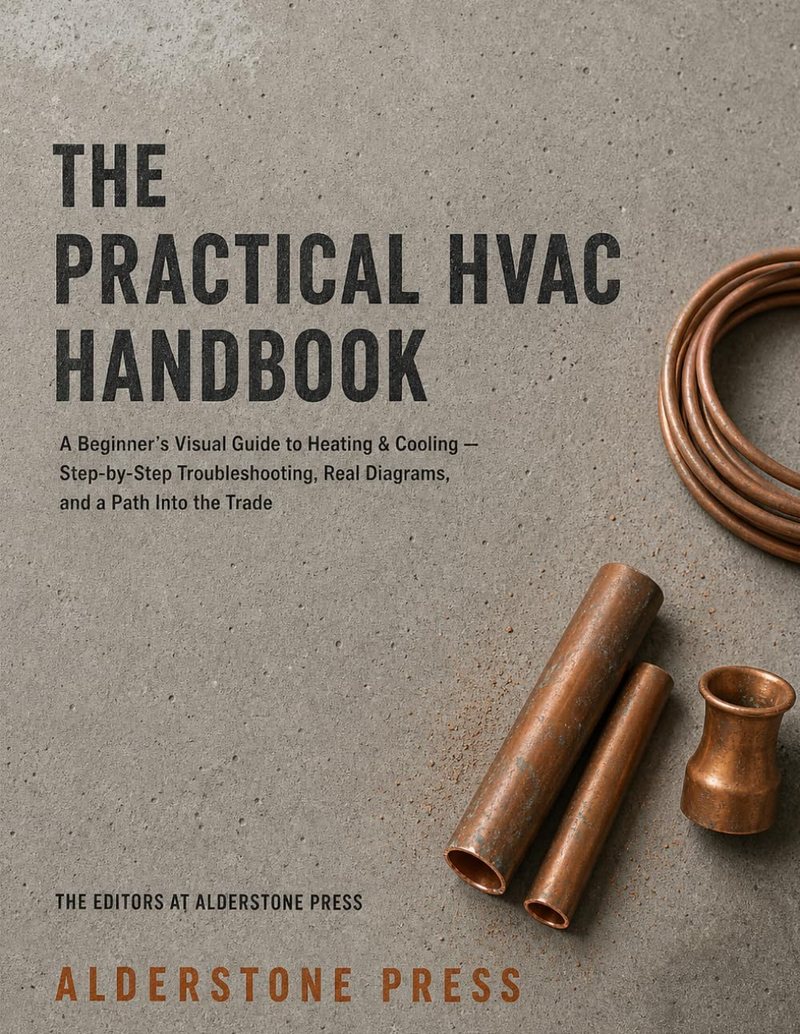
The Practical HVAC Handbook
A Beginner's Visual Guide to Heating and Cooling: Step-by-Step Troubleshooting, Real Diagrams, and a Path Into the Trade
Buy the book
You opened the panel, looked at the tangle of wires and tubing, felt unsure, and closed it again. For a great many people that is exactly where an interest in heating and cooling stops. Not for lack of curiosity, but because the books define the words and never show the work.
Most introductions are walls of text broken by a few small, murky diagrams. You can finish one cover to cover and still not be able to trace the air through your own home, follow refrigerant around its loop, or say what you would check first when the system quits on the hottest afternoon of the year.
This handbook was built to be the opposite. It is a residential-first introduction in which nearly every core idea is taught with a real picture, in plain language, and, wherever a job is genuinely safe for a beginner, as steps you can follow standing at the equipment. The refrigeration cycle, the one concept everything else rests on, is taken slowly and visually until it clicks. And because being checked matters more than being long, the book was reviewed for technical accuracy by a licensed contractor holding universal refrigerant-handling certification.
Inside, you will:
- See how a complete home system fits together, and how it moves both heat and air
- Follow refrigerant around its loop, then measure what it is doing with superheat and subcooling
- Tell a split system, a heat pump, and a ductless mini-split apart, and know how each behaves
- Meet the gas furnace safely: its sequence of operation, its safety devices, and its hard limits
- Read the electrical side without fear, and understand what a meter is actually telling you
- Trace a call for heat or cooling across the R, C, W, Y, and G terminals of a control circuit
- Work three fault-finding playbooks, no cooling, no heat, and poor airflow, as clear decision paths
- Handle refrigerant and certification topics with the awareness the law and the hazard require
Every chapter opens with what you will be able to do by the end of it, and closes with worked examples and review questions whose answers sit in a box, so you can check yourself honestly. Where a real calculation exists it is shown in full, with units: a temperature split becomes an airflow figure, a gauge pressure becomes a saturation temperature and then a superheat value.
A glossary, an acronym and symbol decoder, a units reference, a chapter-level index, and six printable checklists, fault-finding cards, a seasonal maintenance log, a certification study checklist, a starter-tool list, an energy-saving checklist and service-call notes, keep it working long after the first read.
It is equally clear about its limits. It marks plainly where a beginner should stop and a licensed professional takes over, and it states what it does not cover rather than pretending to be a repair manual for everything.
Whether you are trying to understand the machine in your own basement, filling gaps in what you already know, or testing the trade before committing to a career, this is the place to start. Open it at Chapter 1.
- Author
- Alderstone Press
- Pages
- 246
- Trim size
- 8.5 × 0.56 × 11 inches
- Published
- August 25, 2026
- Formats
- Paperback
- Paperback ASIN
- B0HGCY4W8X
More in trades and technical
All trades and technical
Red Seal Automotive Service Technician 310S Exam Prep
Corin M. Haldane
Paperback, Hardcover, Kindle
Red Seal Heavy Duty Equipment Technician 421A Exam Prep
Corin M. Haldane
Paperback, Hardcover
HVAC Electrical Troubleshooting for Service Technicians
Corin M. Haldane
Paperback
Heat Pump Commissioning and Diagnostic Reference
Alderstone Press
Paperback